Binance bStocks vs Kraken xStocks: Backing, Fees and Ownership
Compare bStocks and xStocks on asset backing, shareholder rights, price tracking, dividends, redemption, fees and wallet transfers.
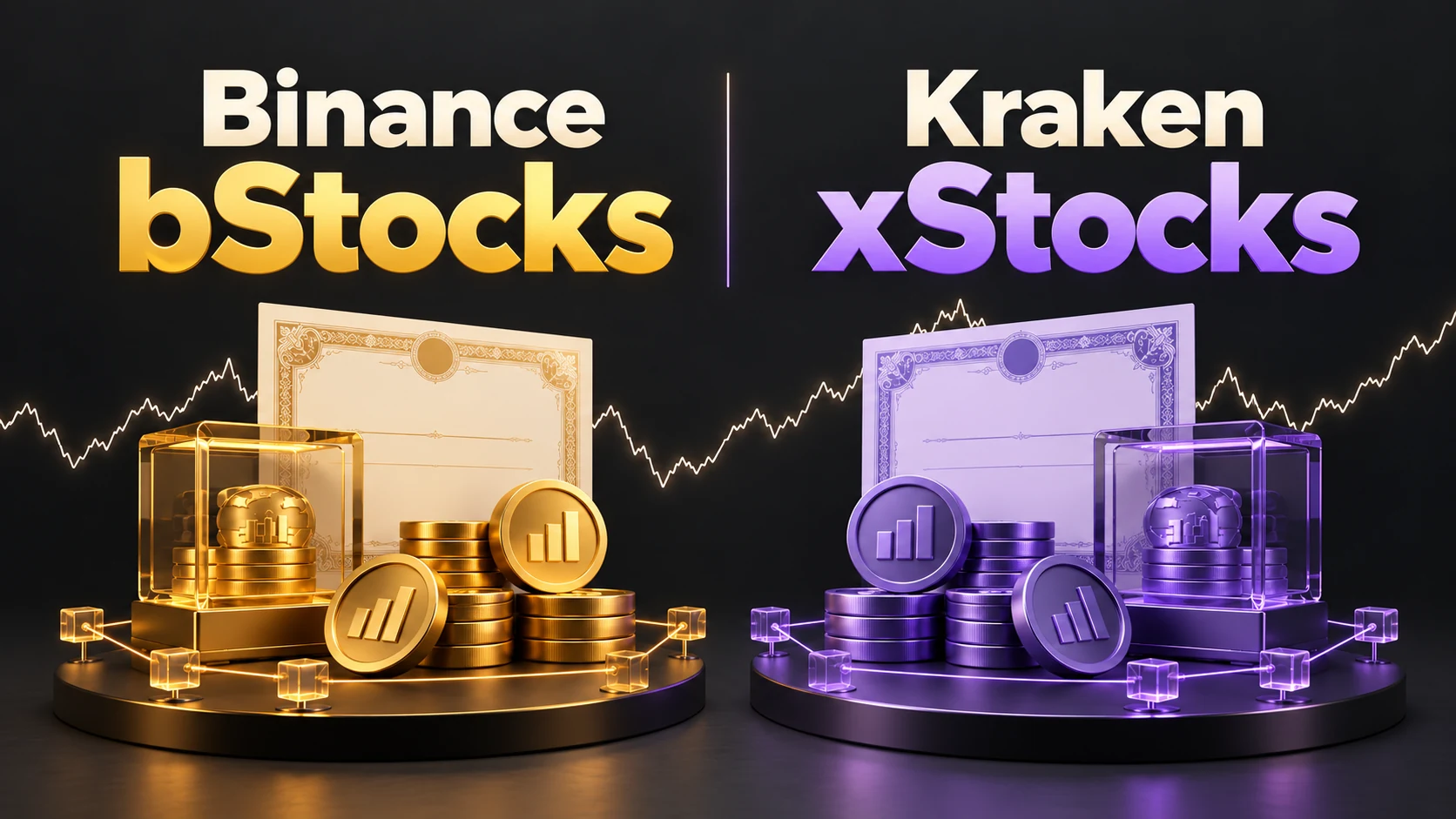
Binance bStocks and Kraken xStocks both let eligible users trade tokenized exposure to stocks and ETFs. Neither makes you a direct shareholder of the referenced company. The useful comparison is what the issuer owes you, how prices stay connected to shares, and how you can exit. This guide compares the tokens themselves, rather than either exchange’s separate stock or perpetual products.
| Feature | Binance bStocks | Kraken xStocks |
|---|---|---|
| Issuer | BTech Holdings Limited (ADGM) | Backed Assets (JE) Limited (Jersey) |
| What you hold | A certificate; no direct shareholder rights | A tracker certificate; no direct shareholder rights |
| Trading hours | Binance Spot: 24/7, subject to interruptions | Kraken Pro: selected assets 24/7, others 24/5; onchain venues may trade 24/7 |
| Wallet networks | BNB Smart Chain (BSC) | Solana, Ethereum, TON and Ink; verify the asset’s withdrawal options |
| Dividends | Net reinvestment through a multiplier | Net reinvestment through rebasing/a multiplier |
| Share conversion | Eligible positions through Binance’s conversion service | Issuer routes, including xPort, require separate onboarding |
What does “backed by shares” actually mean?
Binance says bStocks are intended to be backed by corresponding securities or other eligible assets under the offering documents. xStocks describes 1:1 backing with the underlying stock or ETF in regulated custody. These are disclosed structures, not a guarantee from the underlying company. Read the reserve report’s date, scope and exclusions alongside the legal terms. Token supply alone does not prove custody or recoverability. Binance expressly excludes SIPC and FDIC coverage for bStocks; Kraken’s risk disclosure describes issuer, custodian and platform risks that can cause losses even if the underlying stock performs well.
Why can the token price differ from the stock price?
Backing links the instrument to assets; market makers and eligible issuance/redemption participants help connect prices. In a simplified example, a $100 share and a $103 token can create an incentive to acquire shares, issue tokens and sell them. Fees, eligibility, settlement and liquidity can prevent that trade from closing the gap. Neither product has a guaranteed price peg. Outside share-market hours, token orders can move while the reference exchange is closed. Compare the same currency, timestamp and multiplier-adjusted unit; also inspect the spread and order-book depth.
Are dividends paid into your account?
Both products generally reinvest net dividends into more underlying exposure instead of crediting cash. Taxes and applicable deductions reduce the amount reinvested. A multiplier reflects dividends and share splits. For illustration, 10 raw units with a multiplier of 1.02 correspond to 10.2 adjusted units. This is not free profit: share prices can adjust on the ex-dividend date. For xStocks, Solana and TON interfaces apply a multiplier to raw balances, while EVM contracts return adjusted balances. A wallet’s displayed quantity therefore needs checking before you compare it with the exchange.
Can you redeem tokens for actual shares?
Binance’s conversion service exchanges eligible bStocks and securities positions through Nest Trading Limited. Shares sit in the customer’s sub-account within its omnibus arrangement; the service does not accept arbitrary shares imported from an outside broker. Access and processing conditions apply. xStocks also has an in-kind route: xPort converts shares and tokens for clients onboarded with both the issuer and Alpaca. Issuer access requires KYC/AML and wallet whitelisting. This is separate from an ordinary Kraken withdrawal: you cannot simply send an xStock token to a conventional brokerage account. Selling on an exchange, issuer redemption and transferring securities are different exit routes.
Which has lower fees?
Compare the complete transaction, not just the commission label. Binance’s conversion terms charge no conversion-service fee, but share-leg costs, spreads, taxes and network withdrawals can still apply. Kraken’s fee schedule, checked on 31 October 2026, lists no trading fee for xStocks purchases with USD or USDG in its app; purchases with other assets carry the standard 1% instant-buy fee, and spreads can apply. Kraken Pro’s entry tier lists 0% maker and 0.08% taker fees. Its FAQ contains different Pro figures, so use the dedicated fee schedule and your order confirmation. Conversions, issuer redemption and network withdrawals have separate conditions.
Does self-custody remove the intermediaries?
Both support compatible external wallets. bStocks currently uses BNB Smart Chain and can be subject to transfer controls, including address restrictions. Kraken lists several xStocks networks, but support must be checked for the specific asset and destination. Never send tokens across mismatched networks. Holding your own keys removes reliance on the exchange for storing those tokens; the backing securities still rely on issuers and custodians. Lending or pooling them adds smart-contract, liquidity and potentially liquidation risks. Onchain availability does not override regional restrictions.
Which differences matter for your use case?
For a Binance user who needs eligible share-to-token conversion and BNB Smart Chain transfers, bStocks offers those routes within one ecosystem. For a Kraken user comparing supported networks and external integrations, xStocks is worth examining at the asset level. Neither is a substitute for direct stock ownership if voting rights are essential. Both exclude U.S. persons; Kraken also lists the UK, Canada and Australia among excluded locations, and its FAQ says xStocks are not available in Japan. Check current account eligibility first, then compare the exact security, exit route and executable quote. Without matching those conditions, a universal “cheaper” or “safer” winner would be misleading.
This comparison describes official product terms reviewed on 31 October 2026. It does not verify live reserve sufficiency or account eligibility. The official links below let you check the rules for the product you would actually hold.
Sources
- Binance: bStocks structure, rights and corporate actions ↗
- Binance: bStocks deposits, withdrawals and conversion ↗
- Binance: conversion product terms ↗
- Kraken: xStocks legal structure and risk disclosure ↗
- Kraken: xStocks availability, trading and wallets ↗
- xStocks: asset backing and custody ↗
- xStocks: issuer access and redemption ↗
- xStocks: xPort share-to-token conversion ↗
- xStocks: dividends, splits and multiplier implementation ↗
- Kraken: current app and Pro fee schedules ↗
YOUR BINANCE REFERRAL CODE
- 20% Spot Trading Rebate
- 20% Futures Trading Rebate
- Up to $100 Sign Up Rewards
Available rewards are confirmed during registration.
We may earn a commission when you use this link, at no extra cost to you. Terms and regional restrictions apply.