The short answer
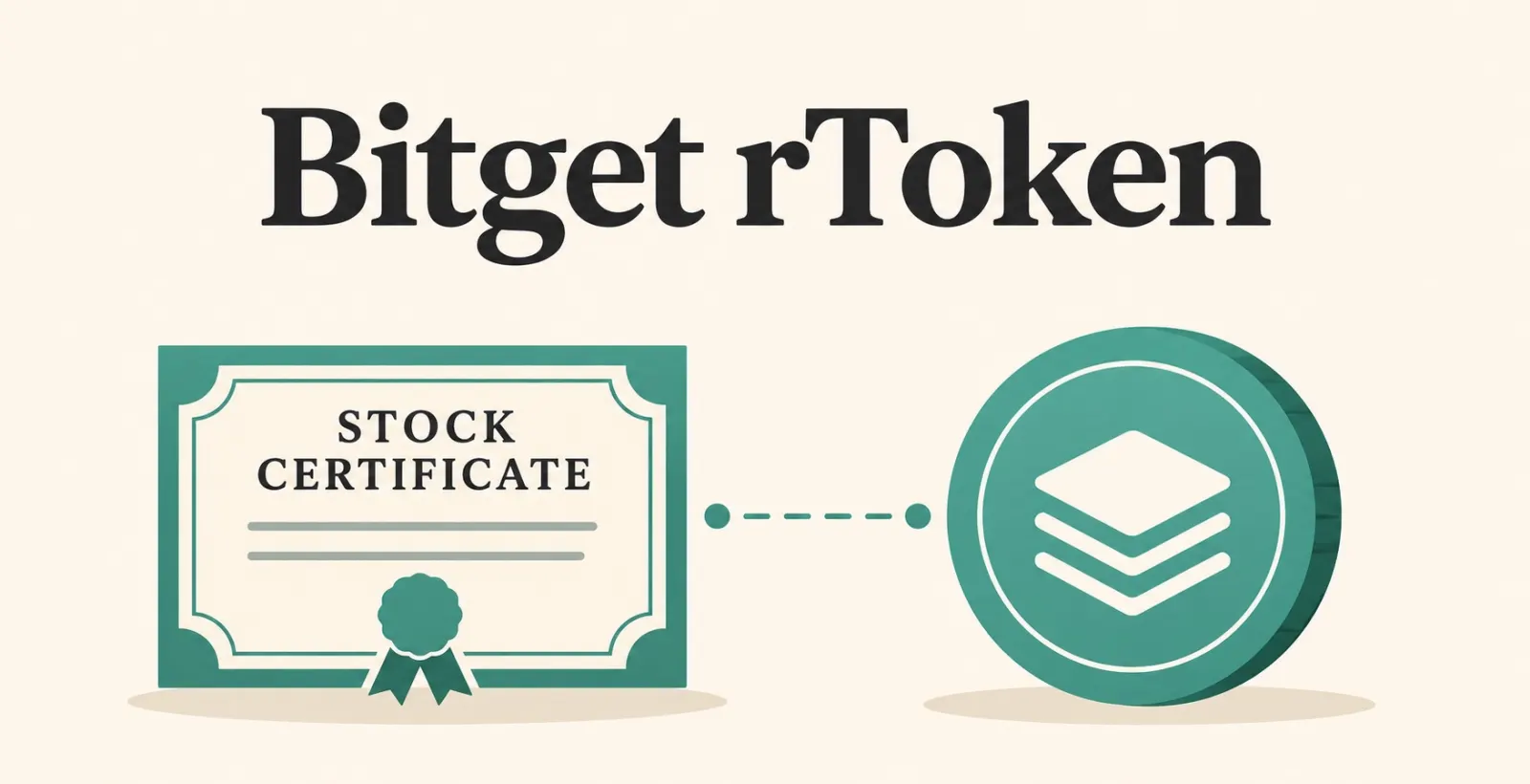
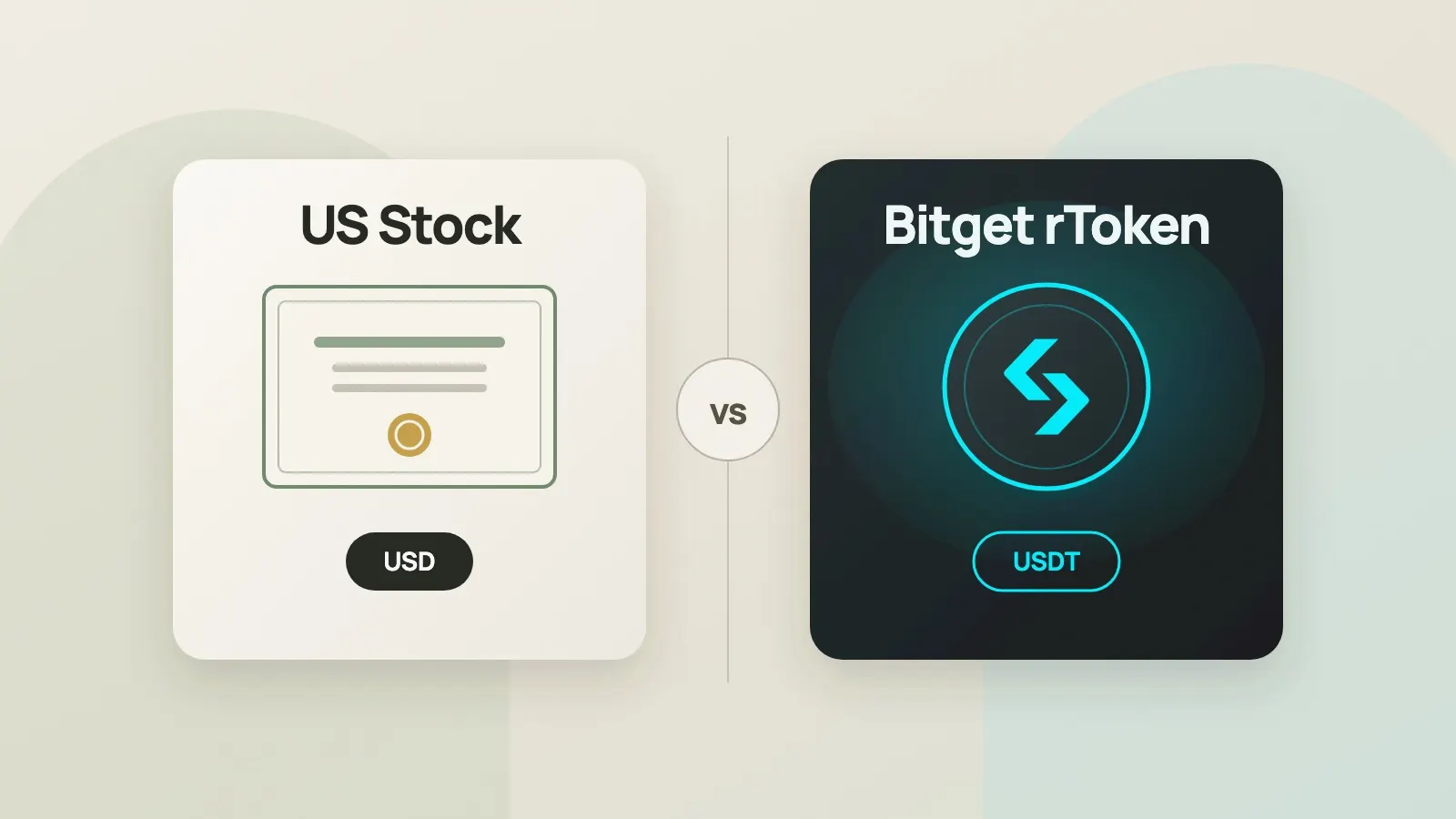
A US stock bought through a broker is a share of the company, held in your brokerage account. A Bitget rToken is a token issued by Reality, Bitget’s tokenization platform, and is designed to track the economic value of one share held in reserve. The price exposure looks similar, but who holds the share, which rights you get, how you pay and which rules protect you all differ.
This article compares the two on four points: the underlying asset and how it is held, shareholder rights, trading currency and capital efficiency, and regulation and trading venue. For how rTokens work and how to buy them, see our earlier Bitget rToken guide.
Underlying asset and how it is held
When you buy a US stock through a broker, the share is usually held in “street name”: the broker’s nominee appears on the company’s records, and your account shows you as the beneficial owner. You have a claim on a security in your own account, under your broker’s customer agreement and the rules for broker-dealers.
With an rToken, the share sits one step further away. Reality holds the underlying stock through a US broker-dealer (Bitget names Alpaca Securities) and issues a token against it. Bitget’s FAQ says each rToken is backed 1:1 by the underlying share, held through a special purpose vehicle, and describes what you hold as an on-chain tokenized claim to the share’s beneficial economic rights rather than registered ownership.
Two things follow. First, your exposure depends on the issuer and its custody arrangements as well as on the company. Bitget says The Network Firm publishes daily reserve attestations; these show the backing but are not a guarantee. Second, the asset is a token. It is created and removed through a mint-and-burn process, and Bitget says supported rTokens can be withdrawn to compatible wallets on Arbitrum and Morph. A share in a brokerage account cannot be sent to a crypto wallet, while a token sent on the wrong network can be lost permanently.
Shareholder rights, voting and corporate actions
A shareholder can vote on directors and other proposals, usually by proxy through the broker, and receives dividends and other entitlements through the account. Bitget says rTokens carry no voting rights and no share registration rights. You get the economic side of the share, not a say in the company.
- Cash dividends: Bitget says eligible net cash dividends are converted to USDT and credited separately rather than reinvested. Its FAQ states that 30% US withholding tax applies regardless of the holder’s location. A non-US investor holding the share at a broker may be able to claim a lower treaty rate by filing Form W-8BEN, depending on their country.
- Taxes: Receiving dividends in USDT does not make them tax-free. Tax treatment depends on where you live and may differ from how a directly held share is taxed.
- Stock dividends and splits: Stock dividends are reflected by issuing additional rTokens, and supported splits and reverse splits are applied to holdings automatically.
- Other events: Mergers and spin-offs are handled in line with the underlying stock, while rights offerings, tender offers and delistings are decided case by case and announced by Bitget. A shareholder can usually choose whether to take part in a tender or rights offer; an rToken holder relies on the terms Bitget announces.
Trading currency and capital efficiency
This is where rTokens are designed to stand out. US shares trade in US dollars, so an investor outside the US usually needs to fund a brokerage account and convert currency. Supported rTokens trade against USDT, so a Bitget user can move from crypto to stock exposure in the same account without opening a brokerage account or holding a separate USD balance.
- Trading hours: US exchanges run set sessions, and some brokers add extended hours. Bitget says all rTokens trade 24/5 (US Eastern Time), covering pre-market, regular, after-hours and overnight sessions, and about 90 major rTokens also trade 24/7, including weekends and US holidays. Bitget provides off-hours liquidity, so depth and spreads can differ from the underlying stock, and prices can gap when the US market reopens.
- Fractional amounts: Bitget supports fractional quantities for eligible rTokens. Many brokers also offer fractional shares, so this is a smaller difference than it once was.
- Collateral and leverage: Bitget says more than 100 rTokens can be used as collateral in its Unified Trading Account, some at collateral ratios of up to 95%, and eligible users can trade rTokens with up to 10x leverage. rTokens can also secure Crypto Loans, with an initial loan-to-value of 78%, a margin call at 85% and liquidation at 91% for many assets. A US margin account generally lets you borrow up to 50% of the purchase price under Regulation T, and brokers can set stricter limits.
- Leverage risk: Using a stock token as collateral puts the same funds to work twice, but a weekend gap or a fall in the stock can trigger a margin call or liquidation across a unified account, including positions in other assets.
- Settlement and transfer: A US stock trade settles one business day after the trade (T+1). An rToken trade settles within your Bitget account, and supported tokens can be moved on-chain.
- Costs: A broker may charge commissions and currency conversion fees. On Bitget you pay maker and taker fees, the spread, the cost of acquiring USDT and any network fees for transfers. USDT itself carries stablecoin risk.
Regulation and trading venue
A US-listed share trades on SEC-registered exchanges such as the NYSE and Nasdaq. US brokers are regulated by the SEC and FINRA and must seek best execution for customer orders. If a SIPC member broker fails, its customers’ securities and cash are protected up to $500,000, including up to $250,000 for cash. SIPC does not cover market losses.
rTokens trade on Bitget, a crypto exchange, not on a US stock exchange, and their prices form in Bitget’s own markets. Bitget describes Reality as a licensed platform, but the public materials we reviewed do not name its regulator. Bitget’s launch announcement says the tokens have not been registered under the US Securities Act of 1933 and may not be offered or sold in the United States or to US persons, and the FAQ says rTokens are generally not available to US persons.
The underlying shares are held with a SIPC member broker-dealer, but the broker’s customer is the entity holding the reserve, not you. Do not assume that SIPC coverage or US investor protections extend to you as a token holder; your recourse depends on Reality’s terms and the law that governs them.
Regulators are watching this structure. In a January 2026 statement, SEC staff said a security remains a security when it is tokenized. The statement described third-party models such as custodial tokens and warned that they can expose holders to additional counterparty, operational and insolvency risks.
Side-by-side comparison
| Topic | Bitget rToken | US stock through a broker |
|---|---|---|
| What you hold | A token giving beneficial economic rights, backed 1:1 by a share held through Reality | The share, held in your brokerage account |
| Custody | Reality’s broker-dealer and SPV arrangement; the token sits in your Bitget account or a wallet | Your broker, under its customer agreement |
| Voting | None | Usually by proxy through your broker |
| Cash dividends | Paid in USDT after 30% US withholding | Paid in cash; a treaty rate may apply with Form W-8BEN |
| Trading currency | USDT | Usually US dollars |
| Trading hours | 24/5; about 90 major rTokens 24/7 | Exchange sessions plus any broker extended hours |
| Collateral | Eligible rTokens in the Unified Trading Account and Crypto Loans | Margin account within broker and regulatory limits |
| Venue and protection | Bitget markets and issuer terms; not offered to US persons | Regulated exchanges and brokers; SIPC at US member firms |
rToken figures come from Bitget’s FAQ as of November 2026 and can change.
What sets Bitget rTokens apart
Several exchanges now list tokenized stocks, and their structures differ. Bitget announced Reality in May 2026 as its own tokenization platform, so issuance and trading are closely linked, much as at Kraken after its parent company bought the xStocks issuer Backed.
Bitget pays eligible cash dividends separately in USDT, while xStocks and Binance bStocks generally reinvest them into the token balance. Bitget also offers around-the-clock trading for about 90 rTokens and accepts more than 100 as collateral. These features suit active traders who already hold USDT; they do not make an rToken the same as owning the share.
Which one fits you?
An rToken may suit someone who already trades on Bitget, wants price exposure to US stocks in USDT, values longer trading hours or wants to use stock exposure as collateral, and accepts issuer, platform and stablecoin risk.
Direct shares may suit someone who wants legal ownership and voting rights, a regulated exchange and broker, investor protection schemes and standard dividend tax forms, especially for long-term holding.
Before buying an rToken, check the specific token and its underlying asset, the latest reserve attestation, trading hours and spreads, fees, dividend and corporate-action rules, supported withdrawal networks and whether you are eligible in your country. Product terms can change.