What Gate TradFi is
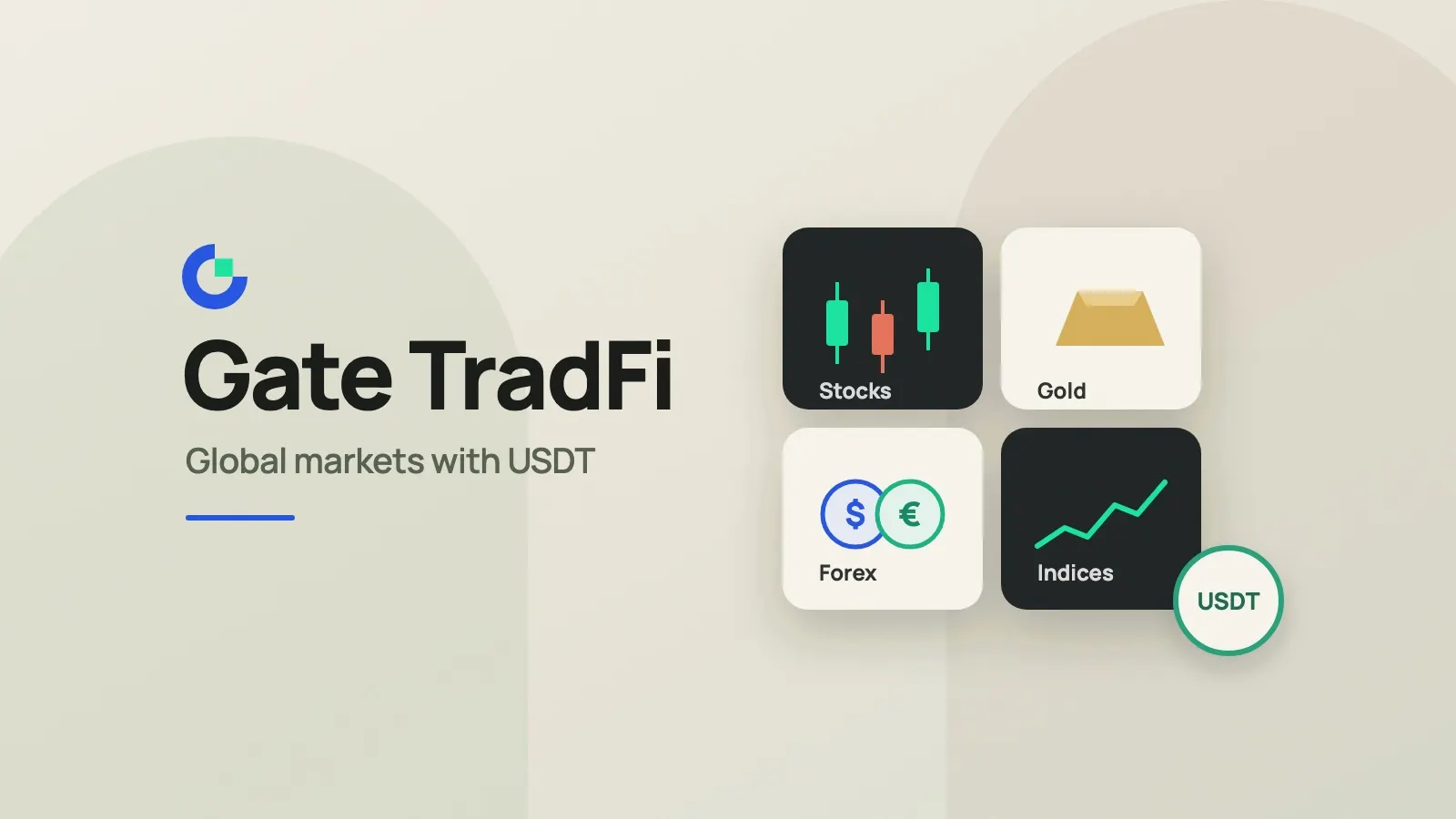
Gate TradFi is the section of the Gate exchange for traditional financial assets: stocks, gold and other metals, forex, global indices and commodities. Instead of opening a separate brokerage account and converting currency, you trade from your Gate account and fund everything with USDT.
In November 2026, Gate’s TradFi page listed more than 12,500 stocks across the US, Hong Kong, Japanese and South Korean markets, more than 500 CFD markets, more than 130 perpetual futures and more than 68 gStocks. The products behind those numbers work very differently, so it helps to look at them one by one.
Four ways to trade
Gate groups TradFi into four products, plus options on US stocks. Gate describes them as follows:
Gate TradFi products compared
| Product | What it is | Suited to, according to Gate |
|---|---|---|
| Gate Stocks | Real shares of US, Hong Kong, Japanese and South Korean companies and ETFs, bought with USDT. Dividends and stock splits are applied automatically. | Long-term investing |
| CFDs | Contracts that track the price of an asset, with leverage, so you can go long or short without owning it | Short-term and two-way trading |
| Perpetual futures | Leveraged contracts with no expiry date on TradFi assets, traded 24/7 | Capital-efficient trend trading and hedging |
| gStocks | Tokens backed 1:1 by underlying shares, which Gate says can be traded 24/7 and moved on-chain | On-chain use of stocks |
Descriptions as published on Gate’s TradFi page in November 2026. Products and listings vary by region.
How Gate Stocks works
Gate Stocks is the product closest to a normal brokerage account. In June 2026, Gate announced US stock trading with Alpaca as its clearing broker: Alpaca handles execution, clearing, settlement and custody, as well as dividends and other corporate actions. At announcement, Gate said users could buy more than 10,000 US stocks and ETFs, including fractional shares from $1. Gate later added listings from Hong Kong, South Korea and Japan.
Gate says fees for US stocks follow its current fee schedule, and that third-party and regulatory fees may be added. Your money stays in USDT until you buy, so you do not need US dollars or a separate overseas brokerage account.
How the CFDs work
Gate expanded its TradFi CFDs in January 2026, covering gold, forex, stock indices, commodities and popular stocks. According to Gate’s announcement:
- CFDs run on MetaTrader 5 (MT5), and your account data and trades sync between the Gate app and the MT5 client.
- You transfer USDT into a TradFi account, where the balance is shown in USDx. Gate describes USDx as an internal accounting unit pegged 1:1 to USDT, not a separate currency or token.
- Leverage is fixed and cannot be changed by the user: up to 500x on major forex pairs and indices, and up to 5x on stock CFDs. Margin is shared across positions (cross margin).
- Trading follows the hours of the underlying markets, including closures, and overnight financing fees apply to positions held open. Gate lists commissions from 0.018 USD per lot.
- If your account’s margin ratio falls to 50% or below, Gate starts closing positions automatically.
gStocks and US stock options
gStocks are Gate’s tokenized stocks. Each token is meant to be backed by an equal amount of the underlying share, and Alpaca says its brokerage infrastructure supports the custody and settlement of those shares. Holding a gStock is not the same as holding the share in a brokerage account: what you own is a token, and your rights depend on Gate’s terms.
Gate also offers options on popular US stocks and ETFs, with several expiry dates and strike prices, settled in USDT. Options are complex products, and Gate itself warns that they carry high risk.
Who can use it
You need a Gate account with identity verification, and some TradFi products require a higher verification level. Gate says some countries and regions are not supported because of local rules, and which products and markets you see depends on where you live.
Risks to weigh
CFDs and perpetual futures use leverage. At 500x, a price move of 0.2% against you equals your entire margin, and Gate’s own risk warning says that most retail accounts lose money trading CFDs. Some countries, including the United States, do not allow retail traders to use CFDs at all.
Your assets are held through a crypto exchange and its partners rather than a local broker, so investor protection may differ from what you would get at home. Tokenized stocks add another layer, because their value depends on the backing shares and on the issuer’s arrangements.
Before you start
Decide which product you actually need: buying shares to hold is very different from trading leveraged CFDs. Check whether Gate TradFi is available where you live, read the product rules, fees and margin requirements for each product, and start small. Listings, leverage and fees can change, so confirm the current figures in the Gate app.
Sources
- Gate: Gate TradFi (opens in a new tab)
- The Block: Gate further expands TradFi feature with CFD trading (opens in a new tab)
- Decrypt: Gate partners with Alpaca for real stock trading access (opens in a new tab)
- Alpaca: Gate partners with Alpaca for US stocks, IPO access and tokenized stocks (opens in a new tab)