What OKX Rubix is
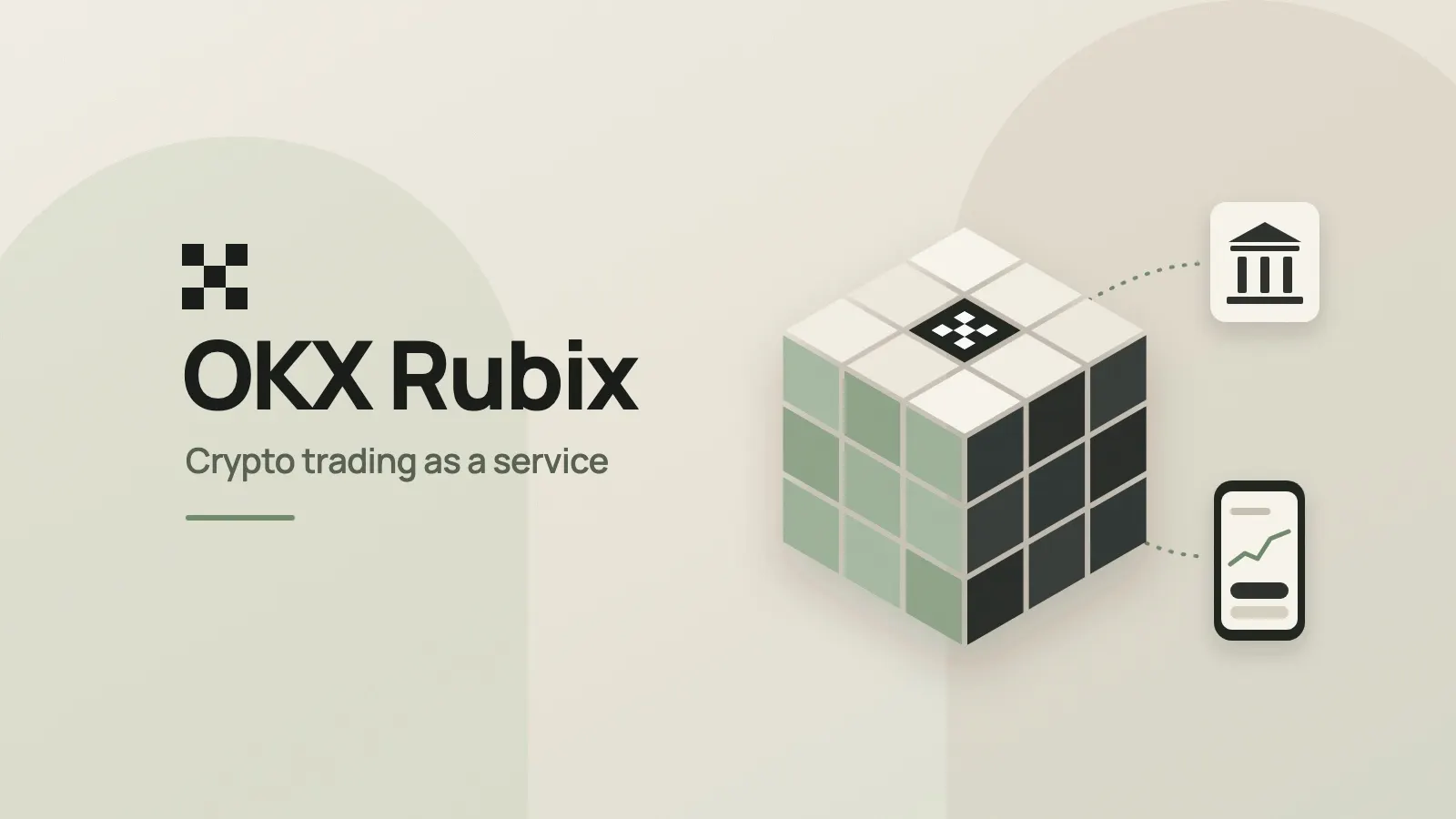
OKX Rubix is a business service from OKX Institutional that lets regulated financial institutions offer digital asset trading to their own clients. OKX calls it “Digital Assets-as-a-Service”: the bank or broker keeps its own app, brand and customer relationship, while OKX supplies the trading, liquidity and settlement infrastructure behind it.
OKX announced Rubix in October 2025. It describes the service as a modular workflow rather than a single platform. An institution picks the parts it needs, such as market access, execution, custody or collateral, and fits them into its existing systems, risk controls and reporting.
Who it is for
Rubix is not a product that individuals can sign up for. OKX’s launch article names these types of firms as intended users:
- Banks that want to add crypto buying and selling next to traditional investments.
- Brokers that want to give clients access to major assets such as BTC and ETH, for example through an existing FX or multi-asset platform.
- Neobanks that want to add crypto trading, stablecoin payments or staking to their apps.
- Private and wealth banks that want to offer regulated digital asset exposure through their existing advisory services.
How it works
OKX outlines the flow in three steps:
- Trade on the partner’s platform: the client places a crypto order in the bank’s or broker’s own app or website.
- Route orders to OKX: APIs pass the order to OKX liquidity and to the custodian and order-management partners the institution has chosen.
- Execute and confirm: the trade is filled and confirmed back to the client inside the same app.
The building blocks
OKX groups Rubix into modules that cover the trade lifecycle. An institution can use some or all of them:
- Regulated access: OKX says Rubix runs through its licensed entities, citing MiCA and MiFID II in Europe, VARA in the UAE, AFSL and AUSTRAC registration in Australia, CNV in Argentina, and money services business (MSB) registration and money transmitter licenses (MTLs) in the US.
- Liquidity and execution: orders can go to OKX’s exchange order books or to over-the-counter (OTC) request-for-quote (RFQ) trading.
- Trade first, settle later: post-trade settlement, so the institution does not have to pre-fund the exchange before each trade.
- Connectivity: FIX, REST and WebSocket APIs, or integration with the order and execution management system (O/EMS) the institution already uses.
- Off-exchange custody: assets can be held with licensed bank custodians or other third-party custodians instead of on the exchange.
- Flexible collateral: leveraged trading backed by fiat, stablecoins, crypto assets and tokenized money market funds.
Where Rubix operates
At launch, OKX said Rubix was already live with institutional partners in Europe, Asia-Pacific, the UAE and Latin America, and that more institutions were being onboarded. OKX has not named the partner institutions on its Rubix pages, and we could not find a public list.
Because each market has its own rules, the setup can differ by region, including which OKX entity is involved and which custodians are available. OKX says that not all products are offered in all regions.
A similar model in Hong Kong
The idea is not unique to OKX. In Hong Kong, licensed exchanges already run the crypto trading inside bank and broker apps. In November 2024, ZA Bank, a Hong Kong virtual bank, launched retail crypto trading in its app using HashKey Pro, a service HashKey Exchange built to let banks and brokers connect to its trading. Futu Securities, the broker behind the Futubull app, started crypto trading in August 2024 through HashKey. Its Hong Kong FAQ now says trades are executed on Hash Blockchain Limited, which operates HashKey Exchange, and on PantherTrade, a licensed platform owned by Futu.
Rubix follows the same pattern: the client deals with its bank or broker, and a licensed exchange handles the trading in the background. The main difference is scope. In Hong Kong, brokers and banks must route crypto trades through a platform licensed by the Securities and Futures Commission (SFC), so these partnerships serve one market, while OKX offers Rubix to institutions in several regions through its own licensed entities. OKX has not named a Hong Kong partner for Rubix.
What it means for individual users
If your bank or broker offers crypto through Rubix, you would trade in that firm’s app and under its account terms, not in an OKX account. The firm sets which assets, fees and limits you see, and its onboarding and identity checks apply. You may not be told which infrastructure provider sits behind the service, so ask the firm if that matters to you.
Rubix does not change how the regular OKX exchange works for individuals. An OKX referral code applies to personal accounts on the OKX exchange or app, not to crypto services that you use through another firm.
Things to keep in mind
Using crypto through a regulated bank or broker does not make the assets less volatile. Prices can fall sharply, and crypto holdings generally do not have the same protections as bank deposits.
Before you trade through any provider, check who holds your assets, what happens to them if the provider or one of its partners fails, and what fees apply, including any spread on the price. Read the provider’s terms and risk disclosures for your country.
Sources
- OKX: OKX Rubix, Digital Assets-as-a-Service (opens in a new tab)
- OKX Learn: Introducing OKX Rubix (opens in a new tab)
- The Paypers: OKX launches Rubix (opens in a new tab)
- HashKey: HashKey Pro supports ZA Bank’s retail virtual currency trading (opens in a new tab)
- The Block: Futu launches crypto services with fiat trading pairs (opens in a new tab)
- Futu Securities: Crypto trading FAQ (opens in a new tab)