What OKX Card is
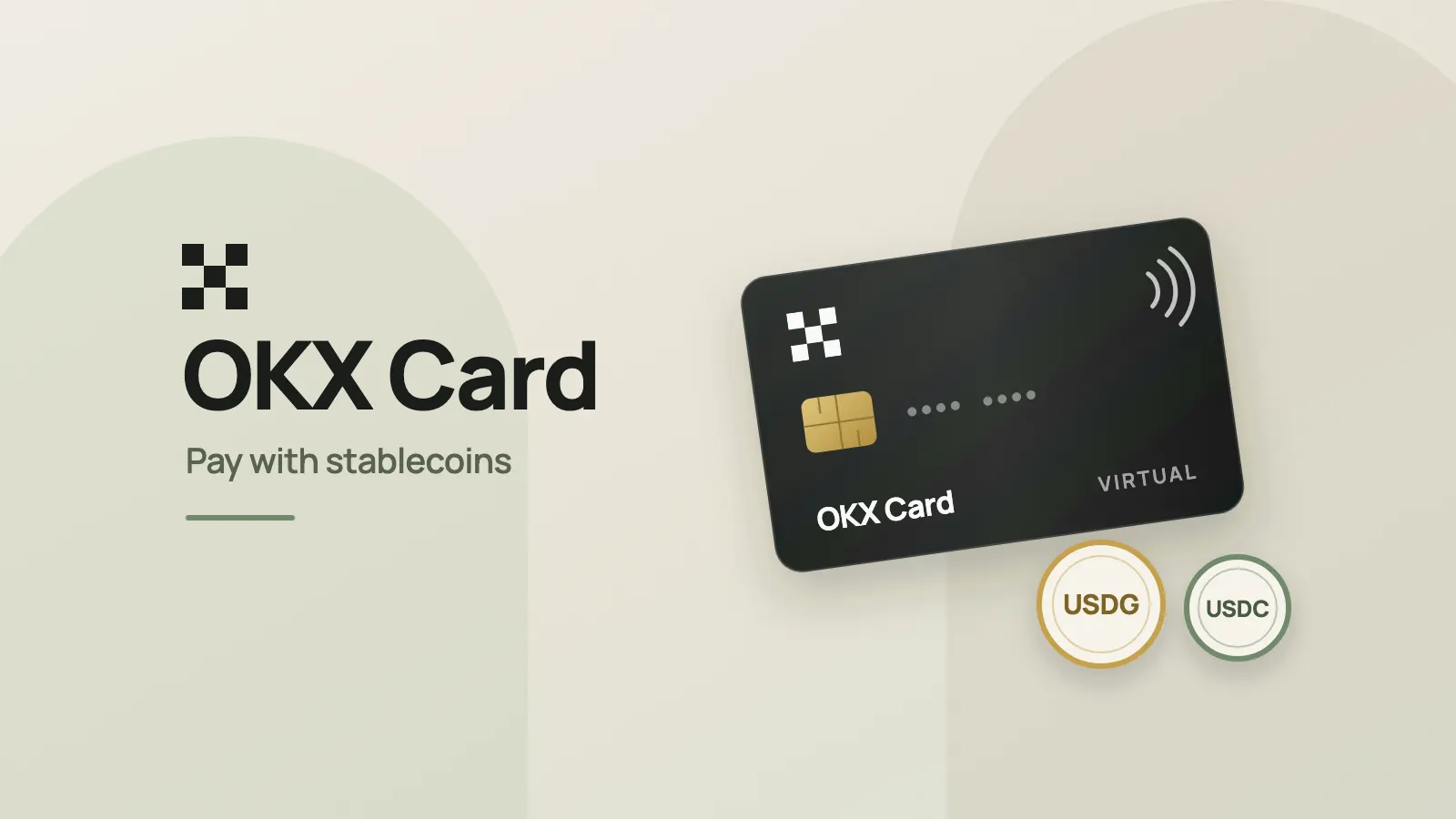
OKX Card is a payment card linked to OKX Pay, the payments account inside the OKX app. Instead of loading euros or dollars onto the card first, you keep stablecoins in OKX Pay and spend them wherever the card network is accepted, online or in stores. Depending on the region, the card runs on Mastercard or Visa.
OKX describes the card as virtual: you get the card details in the app and can add the card to Apple Pay or Google Pay for contactless payments. OKX’s help pages say physical cards are not issued. Terms differ by region, so the sections below separate Europe, the United States and Australia.
How paying with stablecoins works
Merchants still receive local currency. What changes is the funding source behind the card, and that works slightly differently in each market.
- Europe (EEA): You pay from a USDC or USDG balance in OKX Pay, which is converted at the time of purchase. Other crypto must first be converted to USDC or USDG. OKX says there is no credit facility, so a payment is declined if your balance is too low.
- United States: USDC, USDT and USDG in your OKX Pay wallet secure the card’s spending limit, so you do not convert them to dollars first. You repay card spending through Autopay or manually from a linked USD balance.
- Australia: Your OKX Pay balance is held in USDG and converted to fiat when you pay, with a conversion spread. OKX points Australian users to the Product Disclosure Statement for full terms.
Where OKX Card is available
OKX launched the card across the European Economic Area on January 28, 2026, covering EU countries and Norway but not Iceland or Liechtenstein. OKX Europe Ltd. is the licensed entity for EEA users under MiCAR, and the card is issued through a licensed European payment provider.
In the United States, OKX announced the card on November 2, 2026. It is issued by WebBank and available in most states, but not in Massachusetts or New York, or in American Samoa, Guam, the Northern Mariana Islands, Puerto Rico and the US Virgin Islands. In Australia, the card is offered through the OKX app, with Bano Pty Ltd as the product issuer.
OKX says the card is available in select regions only. The simplest check is the Card section of the OKX app: if it does not appear, the card is not yet offered where you live.
Fees
OKX’s main pitch is that it does not add card fees on top of your spending. The details OKX publishes are:
- Europe: no card fee, transaction fee or foreign exchange fee from OKX. A 0.1% market spread applies when stablecoins are converted for a purchase.
- United States: no transaction fees and no foreign exchange fees on purchases.
- Australia: a conversion spread applies when stablecoins are converted to fiat, and you are exposed to the Mastercard exchange rate when paying in another currency.
- Other costs: buying stablecoins, converting other crypto and sending stablecoins from an external wallet can carry their own fees or spreads, and some merchants add their own surcharges.
USDG cashback
Cashback is paid in USDG and applies only to eligible purchases funded with USDG. Spending USDC or USDT earns no cashback. In Europe, the rate and monthly cap depend on your OKX VIP level; see the table below.
Cashback rates in Europe
| VIP level | Cashback | Monthly cap |
|---|---|---|
| Regular | 2% | €10 |
| VIP 1 | 4% | €300 |
| VIP 2 | 4.5% | €450 |
| VIP 3 | 5% | €1,000 |
| VIP 4 and above | 10% | €1,000 |
Rates and caps as published by OKX in May 2026. Check the OKX app for the current figures.
Cashback in the United States
For US users, cashback starts at 2% and goes up to 10% at the highest tier, and it requires Autopay. Your tier is set by the highest of your OKX VIP level, your 30-day average OKX Pay balance or your 30-day card spend. OKX caps rewards at $18,000 a year, with the top rate applying to up to $15,000 of spending a month. At launch, OKX also offered 50% back on select subscriptions, up to $20 a month.
What you cannot use it for
OKX Card is meant for purchases, not for moving money. OKX’s help center says these transactions are rejected automatically:
- ATM and over-the-counter cash withdrawals
- Money transfers, money orders and person-to-person transfer services, including card-funded wallet top-ups
- Buying crypto, funding crypto exchange accounts and other cash-equivalent purchases such as traveler’s checks or foreign currency
- Brokers, investment platforms, forex and CFD trading
- Bail and bond payments, and tax payments to government agencies
How to get OKX Card
The process runs entirely in the OKX app:
- Create an OKX account and complete identity verification. In Europe, you need a valid ID and proof of address.
- Activate OKX Pay.
- Add a supported stablecoin by converting assets you already hold or depositing from an external wallet.
- Open the Card section, apply for the card and activate it.
- Add the card to Apple Pay or Google Pay if you want to pay with your phone.
Things to consider before you apply
Your spending balance is held in stablecoins, not in a bank account. Stablecoins are designed to track the US dollar but carry issuer and platform risk, and holding a crypto balance is not the same as holding a bank deposit.
Cashback is most useful if you are happy to hold USDG and stay within the caps. For a regular European user, the €10 cap is reached after €500 of USDG spending in a month, and anything above that earns nothing extra. Higher rates depend on VIP level or, in the US, on balance and spending. OKX says cashback is subject to promotional periods, so check the current rates and caps in the app.
In some countries, converting or spending crypto can be a taxable event, even for stablecoins, so check local rules. The card is also not available everywhere, and availability, fees and rewards differ by region and can change. Read the terms shown in the OKX app for your country before applying.
Sources
- OKX Help: What’s OKX Card? (opens in a new tab)
- OKX Learn: OKX Card in Europe explained (opens in a new tab)
- OKX Learn: OKX Card is now live in the United States (opens in a new tab)
- OKX Help: What’s OKX Card? (Australia) (opens in a new tab)
- OKX Help: Purchases you can’t make with OKX Card (opens in a new tab)